Uncategorized
On Similar Descriptions of Jesus’ Conception in the Christian Bible and the Quran
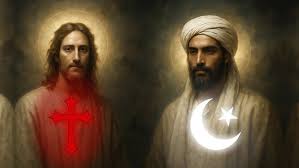 Jesus’ conception within the Virgin Mary is affirmed equally in nonphysical spiritual agency (that is, a “spiritual act of God”) but differently in details in the Christian book of Luke [1:26-38] and in the Quran [3:47; 19:20-21; 66:12].
In Luke the Greek phrase is πνεῦμα ἅγιον ἐπελεύσεται ἐπὶ σὲ, “the holy Spirit will come over [or upon] you.” The word for spirit, πνεῦμα, in Greek can mean “blast, wind, breeze, influence, breathed air, breathe, respiration, spirit of God, spirit of Human, angelic being,” according to Liddell & Scott, A Greek-English Lexicon. The translation here (and elsewhere) also is reasonable as “the holy Wind” or “the holy Breath,” although Christian Trinitarians cannot think of any other translation-option than the “Third Person of the Trinity, the Holy Spirit.”
In the Quran the Arabic phrase is فَنَفَخْنَا فِيهِ مِن رُّوحِنَا, “We breathed into it of our Spirit.” The “it” into which God breathed was Mary’s womb. Here we see the plural, We, which is called the Monarchical “Royal We,” when a single monarch affirms POWER and AUTHORITY using the Plural.
Many centuries before the Quran, we see a Plural Deity in Judaism’s Hebrew text of the Creation of Human Beings in Genesis 1:26. There are Elohim [אֱלֹהִ֔ים] or “gods” doing the creation. We read the Elohim say, “Let us make [נַֽעֲשֶׂ֥ה] the man in our image [בְּצַלְמֵ֖נוּ].” Elohim appears 219 times in Genesis, and more than 2500 times in the Hebrew Bible, in second place behind the name, Yahweh [אֶֽהְיֶ֖ה].
The latter name appears for the first time in Genesis 2:4, when it appears leading off just before Elohim, a kind of hyphenated name for God: “…Yahweh Elohim made the Earth and the Heavens” [יְהוָה אֱלֹהִים–אֶרֶץ וְשָׁמָיִם]. This joint appearance occurs hundreds of times in the Book of Genesis. A literal translation of both names together might be “the One who is the Gods.” Two books later in the Hebrew Bible, in Exodus 3:14, Moses is told by God that the “everlasting name” is Yahweh, which appears 6800 times.
I reject the Jewish “explanations” of the plural as “God speaking to the angelic host,” but believe the plural is residual Semitic polytheism still present in the Hebrew texts, alongside later monotheism.
